
A Quick Bit on Biting
Find and teach something functional that sits between the extremes.

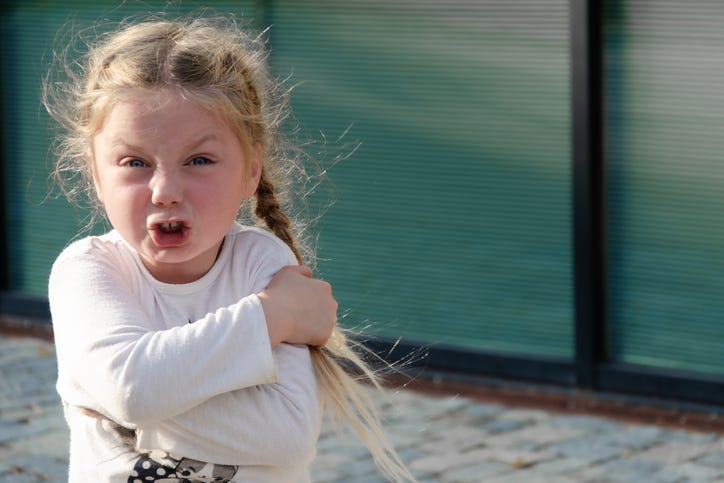
A client informed me about her daughter's recent pattern of biting behavior. Like every aspiring new bike rider, her daughter often found herself falling off their bike and getting hurt. And boy, do those bike incidents hurt. To the child, it hurt so badly that she felt like she might want to hurt someone else, or at least that's what the parents surmised was happening because she had a sudden new pattern of biting a friend if she got hurt on their bike. Her parents thought maybe she was trying to get the hurt out of her body by hurting someone else through biting. Perhaps she was, but functionally, biting was ruining the day. And four-year-olds just want to play! So, I offered the parent this bit (ha!) of advice.
She's definitely trying to communicate something. Behavior is a form of communication; this is a given. If we think about what she's trying to communicate, it certainly could be that she's hurt, dysregulated, and overwhelmed by the hurt. She is also probably so overwhelmed by the hurt that she can't express clearly what she's feeling or wants to say. It could even be embarrassment. Or it could be a combination of multiple things, maybe even that getting hurt disrupted her play, and we know that's really all that matters in the life of a four-year-old, right?
Go-GROW and GET BUSY MAKING CHANGE
From my angle, honestly, the "why" part doesn't matter. We could sit around guessing the "whys" or get busy trying to help her find a new, more functional way to engage with her peers when she is upset.
I think it's best to focus on the what, the how, the who, or the where and leave the "why" for the psycho-analyzers…. Child in Bloom parents are behavior detectives, and we move slowly, pausing to observe a situation and see the facts as clearly as possible. This helps our kids slow down and be less reactive.
I suggested we consider the following questions to guide our approach to helping her daughter:
What happens NEXT when we get hurt?
What CAN we do when we are upset?
What CAN’T we do when we are upset?
How can I get WHAT I NEED when I am upset?
How can I express HOW I FEEL?
Who can HELP?
Where should I go to GET CALMED DOWN?
What are the STOP (never ever) behaviors? Like biting.
What are the GO and GROW replacement behaviors to do instead of biting?
What are the TWO EXTREMES of this?
Positive Extreme
She falls, gets hurt, and politely says, "That hurts." No drama, no tears, and no biting. (Of course, this is highly unlikely.)
Negative Extreme
She falls, gets hurt, and bites her friend through the skin. (YIKES! This is not going to work for her).
Something In Between
What are the functional, middle-of-the-road behaviors she could choose instead of the negative extreme of biting?
OPTION 1: She could cry out, "I don't like you when you hurt me," to a friend who knocks her off the bike. It's not nice to yell at friends, but this is way more functional than biting.
OPTION 2: She could say, "I feel like biting!" This is more functional than actually biting.
OPTION 3: She could yell, "ARGGH!" like a pirate to feel better and release her stress… Again, this is more functional, and it gets the job done, so she feels a sense of release. And it's pretty cool and distracting to act like a pirate when you are in preschool.
NOTE: We will work on making these less-than-perfect options more acceptable as a next step, but at least we are beginning to phase out the biting.Positive Extreme…
PARENTS PAUSE- TEACH, MODEL, PRACTICE, PRAISE- the new options
I let the parents know that they will need to PAUSE when their daughter is in a calm and curious state (outside the moment) and take time to connect by TEACHing, modeling, and practicing the new way.
Teach through MODELing, which means drawing or acting it out with the child. You could even demo with a teddy bear falling off the bike. Show her that there are options for the bear by having the bear choose a new response that is more functional and fun for everyone!
Before you go outside to play the next time, help her to FAST FORWARD and look ahead by giving her a heads-up reminder of what we DO or DO NOT do when we are hurt.
Then, PRAISE any bits of progress (anything moving towards positive is worthy of note). Then, we will help the child begin to break the pattern and make it new again with fun and function at the center of it!
Want to learn what happened next? As they usually do, the parents and child came up with an even better new option that worked to change the behavior pattern. Read Parent Response: A Bit on Biting to learn how it worked out.

For more small parenting shifts that create big changes in kids, order my book: Child in Bloom: Practical Advice for Parenting Through the Growing Years
Who wrote this?
I am Dr. Renee Mattson, a licensed intervention specialist with 30+ years of experience presenting and coaching in schools, homes, & university settings. All my knowledge and wisdom is in my book: Child in Bloom: Practical Advice for Parenting Through the Growing Years. I know 1st hand that small shifts in adult behavior can lead to big, lasting changes in kids, which is what this newsletter is about—sharing small parenting shifts that create big changes in kids. Read more.